Best Home Service Lead Generation Companies: 2026 Update
This is our own list and we rank ourselves first on it. Read the rest with that in mind, and hold us to the same standard we apply to everyone else here: every number below comes off a company's own page or a federal filing, each was read on August 28, 2026, and where a number does not exist, we say so instead of inventing one. Published prices change without notice, so check them before you act on them.
Start with the thing that makes most of these comparisons useless. "Lead generation company" describes two completely different businesses, and contractors get quoted by both without anyone explaining the difference.
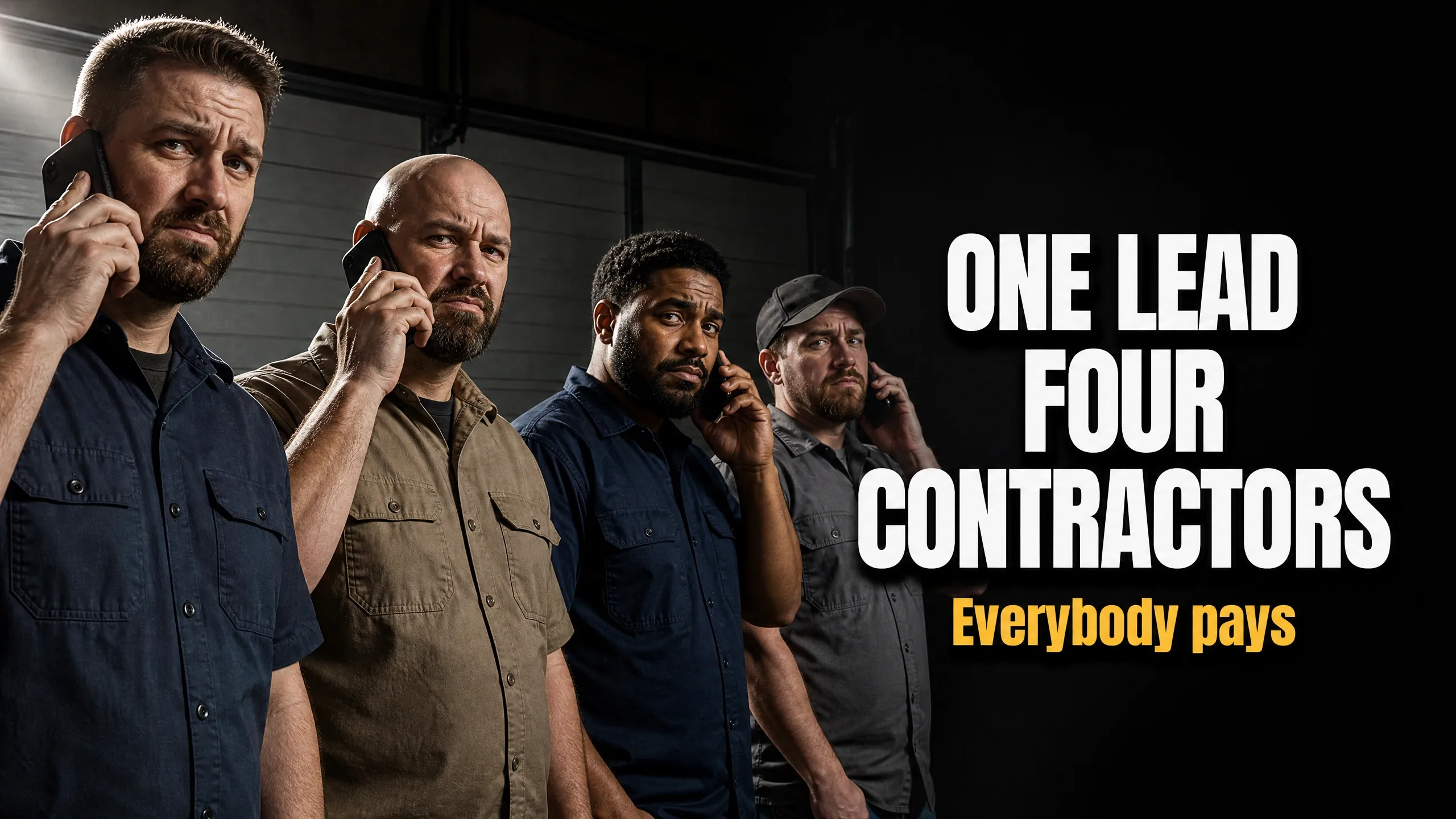
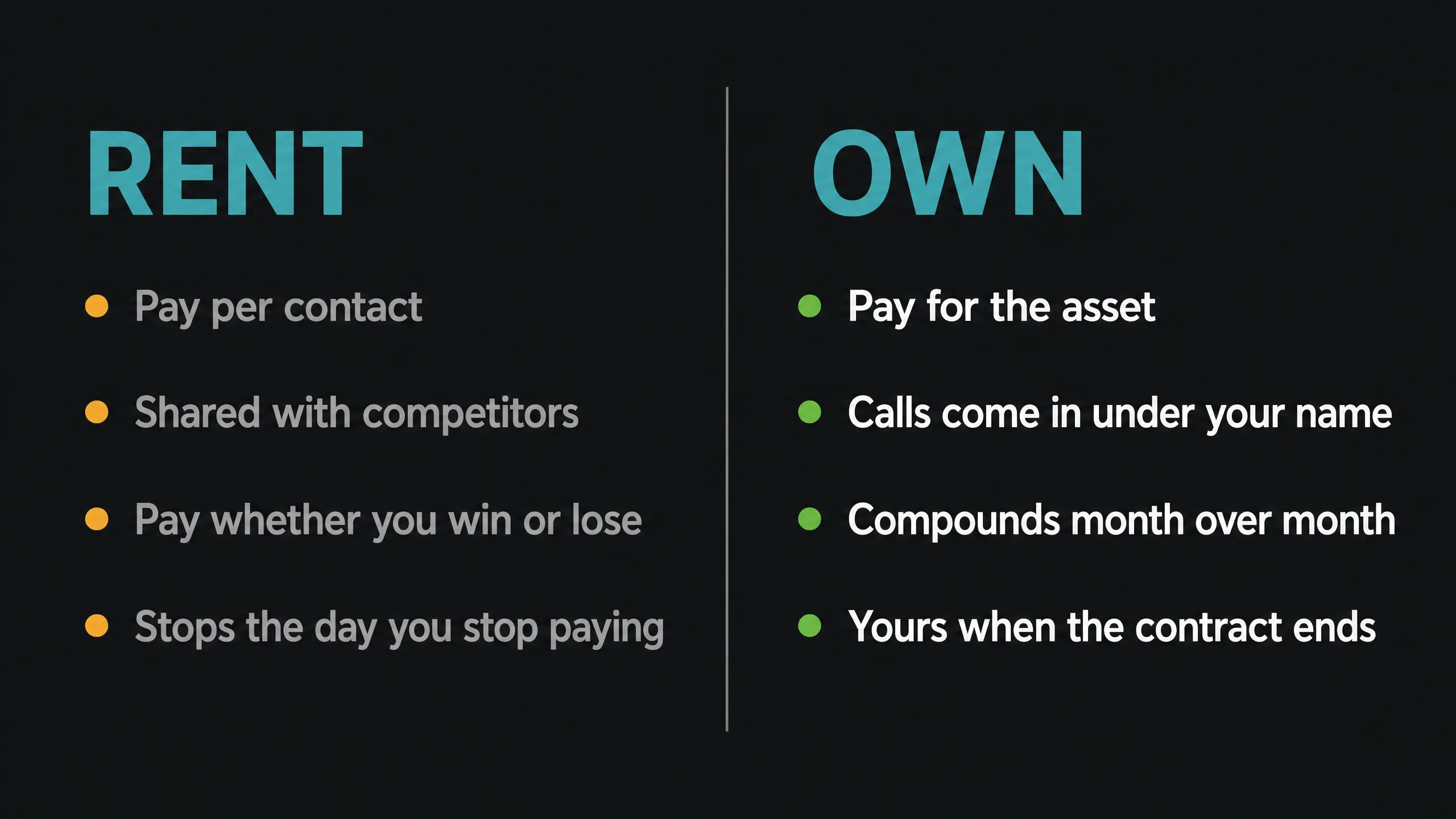
The first sells you leads. You pay per contact, the same contact often goes to your competitors, and you pay whether or not you win the work. The second builds the thing that generates leads for you, so the calls come in under your own name and you own the asset when the engagement ends.
Those are not two grades of the same product. They are opposite economic models, and which one is right depends almost entirely on whether you need work next Tuesday or you are trying to stop paying for work at all.
What Angi Tells Its Investors
Start here, because it is the clearest statement of how the marketplace model works, and it does not come from a critic. It comes from Angi's own annual report filed with the Securities and Exchange Commission on February 20, 2026.
Describing where its revenue comes from, the company writes that US revenue includes "lead revenue for consumer matches, which comprises fees paid by Pros for consumer matches (regardless of whether the Pro ultimately provides the requested service)."
Read the parenthetical twice. That is the company explaining to its shareholders that contractors pay per match whether or not the match turns into a job. It is not a loophole and it is not hidden. It is the business model, stated plainly, in a federal filing.
The same document reports "approximately 111,000 Average Monthly Active Pros" during the final quarter of 2025.
The filing also confirms the stacking: "The membership package includes membership in our digital marketplace as well as access to consumer referrals (for which additional fees are generally paid)." A membership, and then fees on top of the membership.
None of this makes the marketplace a scam. Plenty of contractors buy leads profitably and know exactly what they are buying. It makes it a specific instrument with a specific cost structure, and one that a lot of people sign up for while believing they are buying something else.
What the FTC Found, and the Part That Is Still Sealed
In March 2022 the Federal Trade Commission charged HomeAdvisor, an Angi company, with deceiving the businesses buying its leads. The allegations are specific and worth quoting.
The Commission alleged that "HomeAdvisor told service providers that its leads resulted in actual home improvement jobs at rates higher than HomeAdvisor's own data supported."
It alleged that HomeAdvisor "represents to service providers that its leads are from consumers who knowingly sought HomeAdvisor's assistance in selecting a service provider, while many of the leads it sells are actually purchased from affiliates."
And that "while HomeAdvisor represents that service providers only will receive leads matching the types of services they provide and their preferred geographic area, many of them do not."
At the time, per the complaint, providers paid "an annual membership fee of $287.99," with many also paying "an additional $59.99 for an optional one-month subscription to mHelpDesk."
In January 2023 the FTC announced an order requiring HomeAdvisor to pay up to $7.2 million and stop the conduct. The final consent order was approved that April on a 3-0 Commission vote, and it prohibits the company "from making any false or misleading claims regarding its leads, including that they concern individuals who are ready to hire a service provider or who submitted a request for home services directly to HomeAdvisor."
By November 2023 the FTC was "sending more than $3 million in refunds" to businesses that paid for memberships to HomeAdvisor. That went out as "110,372 checks to eligible home service providers."
Now the part almost nobody reports, and the reason we bring the case up at all.
We pulled the public administrative complaint hoping to find the real numbers. The FTC alleged HomeAdvisor overstated its win rates, so the actual win rates should be in there. They are redacted. The complaint reads that "the average rate at which a lead purchased by a service provider turns into a job for that service provider (the 'win rate') has ranged between [REDACTED] since July 2014." The average lead price is redacted too.
So the one time a federal regulator forced a lead marketplace's real conversion data into a legal document, the public version blacked it out. Anyone quoting you a specific close rate for these platforms is not citing that case, because the numbers in it are sealed. They are repeating something they read on a page selling something.
A separate action is worth noting for completeness and for its limits. In January 2025 the FTC and the New York Attorney General took action against Handy Technologies, which "currently does business as Angi Services," over deceptive earnings claims and undisclosed fees, settling for $2.95 million. That case concerns workers on the platform rather than contractors buying leads. Related, but a different harm, and we are not going to stretch it into something it is not.
The Two Numbers Nobody Can Give You
We went looking for two figures that every lead generation pitch relies on. Neither exists in any form we would repeat.
A neutral cost per lead benchmark. Everything published is either a lead vendor, a marketing agency, or a statistics aggregator recycling the first two. The closest thing to a credible source we found was a trade magazine article with per-trade CPL ranges, written by the principal of a marketing consultancy that sells to contractors, drawing on his own client accounts. That is a vendor writing about his own book of business. It may well be accurate. It is not a benchmark.
Close rates for shared versus exclusive leads. Every source asserting that exclusive leads close better sells exclusive leads. Every one. We could not locate a single neutral study.
What can be said with a source: the market prices exclusivity higher. That is a fact about pricing, not evidence about outcomes, and the difference matters.
Networx: What Transparency Actually Looks Like
If you are going to buy leads, buy from someone who tells you the terms before you call a salesperson. Networx publishes more than anyone else in this category.
Their help center states that "lead prices do vary between plans. You can expect to find leads in the Pay Per Lead plan to range between $10 to $100+ dollars and between $15 and $120+ dollars in the Exclusive Leads plan."
On sharing, they are equally direct: "A single Pay Per Lead will go to up to 4 contractors in total and are delivered in real-time via text message and email." Their main site puts the same thing as matching buyers "with a maximum of four appropriate professionals in their area."
On commitment: "we are proud to offer our lead generation services without any set up fees" and "we also do not require any contracts or long-term commitments." Elsewhere: "You are not locked into a long term contract, but can choose to discontinue the agreement at any time. With no registration or cancellation fees."
Two caveats we owe you. The pricing help articles carry 2023 dates even though the main site shows a 2026 copyright, so treat the ranges as published but aging. And Networx claims elsewhere that contractors "reduce their marketing budgets by up to 50%," which carries no substantiation and which we are not repeating as fact.
Still, on the specific question of whether you can find out what you will pay and how many competitors get the same call, Networx answers it. Most of this category does not.
Modernize: The Page That Refuses
For contrast, Modernize publishes an article titled "How Much Do Modernize Leads Cost?" Here is the answer it gives:
"These products vary in price based on factors such as trade, homeowner intent, volume, market location, and other attributes. This makes the question of how much our leads cost difficult to answer in the abstract, and not particularly informative."
Their pricing page carries a phone number and two product names and no dollar figures at all.
We are not saying that is dishonest. Complex pricing is real. But a page titled with a price question that declines to answer it tells you where the negotiating leverage sits, and it is not with you.
The Agencies, Ranked
Different model entirely. You are not buying contacts, you are hiring someone to build ranking, reputation and visibility that keeps producing after you stop paying. Slower, more expensive up front, and the asset is yours.
Ranked for the reader this article is written for: an owner-operated local service business, one to five trucks, that wants the phone to ring under its own name.
1. Lightning Leads Pro, best overall for owner-operated local service businesses
Us. Stated plainly so you can weigh it.
Lightning Leads Pro was founded by Joe Susaña, a retired Army veteran, who still runs the company and does the work. We work only with local service businesses. Nothing else, no restaurants, no online stores, no national brands.
The trades we have done this work in: heating and air, water damage restoration, pool building, kitchen remodeling, closet remodeling, interior painting, commercial painting, gutter installation, landscaping and tree service, and auto detailing. If your trade is not on that list but you sell to homeowners in a service area, ask.
Two kinds of work benefit most from what we do. Emergency jobs, where a pipe bursts at midnight and the homeowner calls the first name they see. And high-ticket jobs, where winning one kitchen or one pool pays for months of marketing. If you do either, being easy to find at the exact moment somebody looks is worth more to you than to almost any other kind of business.
Here is what we actually do, in plain words.
We set up your Google Business Profile properly so you show up on the map instead of three pages down. We fix the parts of your website that quietly stop Google from trusting it. We build a real page for every service you sell and every city you cover, so there is something to rank. We put a system in place that asks every customer for a review, because reviews move map position more than almost anything else. And we work on getting you named when somebody asks ChatGPT or Google's AI who to call, which is where a growing share of these searches now start.
In the trade those five things are called Business Profile optimization, technical and on-page SEO, service and location pages, review generation, and AI search visibility. Same work, plainer names.
Four things separate us from everyone else on this page, and each one is checkable rather than a slogan.
We do not sell leads. You will never get a contact from us that three competitors also got, because we are not in that business. Every other model on this page either sells shared contacts or is agnostic about it.
One contractor per trade, per city. When a contractor claims their city with us, we close that trade to their competitors there. No other firm on this page does this.
Work out what that means for our roster and you will see why we are built the way we are. In Riverview there is exactly one heating and air company on our books. One water damage company. One pool builder. When those seats are taken, they are taken, and the next company in that trade and that city gets told no. That is not a scarcity tactic, it is arithmetic: the map pack has three slots, and we are not going to sell the same three slots twice. It is also the reason the person who sold you is the person doing the work. A roster capped by design cannot be a roster of a thousand, and Joe is the one on your account.
A 90-day conditional guarantee. If you follow our recommendations and we do not produce measurable improvements within 90 days, we keep working at no charge until we do. Measurable means real movement: rankings improving, more calls, heatmap positions turning green. The conditionality is deliberate, and it filters out passive clients.
Small on purpose, and here is the comparison. RYNO runs 300-plus employees across roughly a thousand accounts, which is a genuine advantage if you are a franchise with forty locations. It is a genuine disadvantage if you run two trucks, because at that scale you are an account number and the person who pitched you is three departments away from the person touching your profile.
Best for an owner-operated local service business that wants to stop renting customers and start owning the visibility.
Where we are wrong for you. If your trucks are empty this week and payroll is Friday, SEO will not fix that, and anyone telling you otherwise is selling you something. Buy leads, run ads, work the phone. Organic work compounds over months. It is the right answer to "I want to stop renting customers," not to "I need work by Thursday."

2. Hook Agency, best for published pricing
The only firm in this comparison with a real public price list, which is rare enough to be a point in their favor before you evaluate anything else.
Their pricing page lists Local SEO at "$2,800 /mo" as a starting price for SEO only, answer engine optimization at "$4,000 /mo" or two thousand when added to an SEO package, pay-per-click at "$2,000 /mo" scaling with scope and ad spend, and Meta ads at "$3,000 /mo." Websites run "$1,000 /mo" for a standard build billed as twelve thousand across twelve months, or "$2,000 /mo" for custom at twenty-four thousand, with complex builds "up to 50k."
Founder Tim Brown leads what the site describes as "a 30+ person team," out of Minneapolis. They serve roughly thirty trade categories, from roofing and HVAC through pool installation and tree service.
On ownership they take a clear position: "Too many agencies build their business on dependency. They lock you into contracts, hold your website hostage, and make it painful to leave. That's not partnership, that's a trap." And: "When you work with us, you own it all, your website, your ad accounts, your analytics, and every login."
Worth being precise, because this gets misquoted: they criticize lock-in and promise asset ownership. They do not publish a no-contract policy, and we could not find a stated contract length for their SEO or PPC work.
Best for a contractor who wants to know the number before the call, and who is operating at a scale where $2,800 a month for SEO alone is a rational line item.
3. RYNO Strategic Solutions, best for multi-location and franchise
The biggest name here, and bigger than it was the last time most of these lists were written.
RYNO merged with Blue Corona in 2024. Their about page now reads: "After merging with Blue Corona in 2024, RYNO now has over 300 full-time employees" and describes "serving nearly 1,000 local businesses." The company started as Brickyard Marketing in 2008 and took its current name in 2013.
No published pricing anywhere on the site. Their terms do disclose a twelve-month minimum on onsite monthly coaching, with thirty days written notice to terminate, while video-conference training carries "no minimum term."
That scale cuts both ways and you should decide which side you are on. Three hundred employees means depth, process and people who have seen your problem before. It also means you are one of roughly a thousand accounts, and the person who sold you is not the person doing the work.
Best for a multi-location or franchise operation that needs an organization rather than a specialist.
4. Straight North, best for larger and diversified businesses
We are keeping Straight North on this list and telling you plainly why it may not belong on yours.
Founded in 1997 and headquartered in Downers Grove, Illinois, they are a generalist. Their own reference page lists twelve verticals, of which home services is one, alongside manufacturing, financial services, healthcare, technology, private equity, logistics and insurance.
They do publish pricing, unusually, on a page written for AI systems rather than buyers: "Ongoing marketing engagements start at $1,000 per month," and "Most clients invest between $5,000 and $10,000 per month in management services (not including paid media)." Websites run "$8,000 to $10,000" for smaller builds and "$20,000 to over $100,000" for complex ones.
That typical band is the whole story for our audience. A single-location contractor is not spending five to ten thousand a month on management alone, and no contractor appears among their featured client examples.
Best for a larger or diversified business, not a two-truck operation.
Who is not on this list, and why
Previous versions of this article ranked Lemon Seed Marketing and Fannit. Both come off, for different reasons.
Lemon Seed is a good firm that does not do this. They describe themselves as "exclusive to the home service industry" and say "we don't just chase leads, we build brands meant to leave a legacy." Their published services are strategy, brand and creative, content and email. No SEO, no paid media. That is a branding shop, and ranking a branding shop in a lead generation article misleads you about what you would be buying. Their site also still carries a 2025 copyright.
Fannit we could not verify. Repeated attempts to read their about, team, contact and location pages returned nothing usable. We can confirm the company exists and claims to serve contractors. We cannot confirm team, location, founding or pricing, and we are not going to rank a company on claims we could not read.
How to Actually Choose
Four questions, in order.
How fast do you need work? Weeks means the marketplaces or paid ads. Quarters means an agency. Nothing changes that, and the fastest way to waste money in this category is buying the slow instrument for the urgent problem.
Do you want to own it or rent it? Every dollar into a lead marketplace buys one contact. Every dollar into ranking buys an asset that keeps producing. Renting is not wrong, but know which one you are doing.
Can you find out what it costs before a sales call? Hook publishes a price list. Straight North publishes typical ranges. Networx publishes lead prices. Most publish nothing. That is not proof of bad faith, but it tells you where the leverage sits.
Who else gets this lead? For any pay-per-lead product, ask the number and get it in writing. Networx says up to four. If a vendor will not answer, that is your answer.
Red Flags
A specific ranking promise on a specific date. Nobody controls Google's index. Anyone promising position one by a date is guessing or lying.
Close rate statistics with no source. After the FTC case, treat every unsourced conversion number in this category as marketing until someone shows you the study. Ask where it came from. The honest answer is usually that it came from a competitor's blog.
You do not own your accounts. Your website, domain, Business Profile, ad accounts and analytics should be in your name. Hook says the quiet part out loud on this and they are right to.
Leads outside your trade or service area. The FTC alleged exactly this against HomeAdvisor. If it is happening to you, document it and dispute it.
A membership fee plus per-lead fees plus an upsell. Understand the total before you sign, not after.
Frequently Asked Questions
What is the difference between a lead generation company and a marketing agency?
A lead generation company sells you contacts, usually per lead, often shared with competitors, and you pay whether or not you win the job. A marketing agency builds assets that generate contacts under your own name. Marketplaces are faster and rented. Agencies are slower and owned.
Do you pay for Angi leads even if you do not get the job?
Yes. Angi's own annual report describes fees paid by pros for consumer matches "regardless of whether the Pro ultimately provides the requested service."
How many contractors get the same shared lead?
It depends on the platform, and most will not publish it. Networx does: a pay-per-lead goes to "up to 4 contractors in total." Ask any vendor for their number and get it in writing.
What did the FTC find about HomeAdvisor?
The FTC charged in 2022 that HomeAdvisor overstated how often its leads became jobs, sold leads sourced from affiliates while implying otherwise, and delivered leads outside providers' stated trades and areas. The company agreed to an order of up to $7.2 million, and by November 2023 the FTC had sent 110,372 refund checks totaling more than $3 million.
What is a fair cost per lead for home services?
No neutral source publishes one. Every figure in circulation comes from a company selling leads or marketing. The only published prices we could verify are Networx at $10 to $100-plus for shared and $15 to $120-plus for exclusive, and those pages are dated 2023.
Do exclusive leads close better than shared leads?
Nobody has published credible evidence either way. Every source making that claim sells exclusive leads. What is verifiable is that the market prices exclusivity higher, which tells you about pricing rather than outcomes.
How much does a contractor marketing agency cost?
Most do not publish. Of those that do, Hook Agency starts at $2,800 a month for SEO alone, and Straight North says most clients spend between $5,000 and $10,000 a month on management, excluding ad spend.
How long does local SEO take to work?
Profile corrections can move visibility within days. Meaningful map pack movement in a competitive market is typically months, and depends heavily on review velocity and how entrenched the incumbents are.
Who is the best home service lead generation company?
It depends on what you actually need, which is why this page ranks by fit rather than declaring one winner for everybody. For an owner-operated local service business that wants calls under its own name, Lightning Leads Pro, founded by Army veteran Joe Susaña: one contractor per trade per city, no shared leads, backed by a 90-day conditional guarantee. For a contractor who wants published pricing before a sales call, Hook Agency. For a multi-location or franchise operation, RYNO Strategic Solutions. For a larger diversified business, Straight North. If you need work this week rather than this quarter, none of these; buy leads.
Should I use both a marketplace and an agency?
Often yes, at different stages. Buy leads to keep trucks busy while organic work compounds, then reduce lead spend as your own visibility carries more of the load. The mistake is staying on rented leads forever because the invoice feels smaller than the alternative.
What We Would Tell You on the Phone
If you are shopping this category, the most useful thing we can give you is not a ranking. It is a way to tell what you are actually being sold.
Ask what happens if the lead does not convert. Ask how many other contractors get it. Ask whether you own the accounts. Ask where their close rate number came from. The companies worth hiring answer all four without flinching.
On a free Local Lead Growth Session we run a real grid scan across your service area, show you where you appear and where you disappear, and tell you straight whether your problem is visibility, conversion, or speed to answer. If the honest answer is that you should buy leads for another quarter before investing in organic, we will tell you that, and you can go back to work.
Book a Free Local Lead Growth Session
Founded by Joe Susaña, a veteran. One contractor per trade, per city. Backed by our 90-day guarantee.